
Views: 0 Author: Site Editor Publish Time: 2026-08-10 Origin: Site


Formulating essential oil blends requires strict mathematical precision. Relying on visual estimation compromises product safety and ruins batch consistency. Miscalculating the volume and drop count in a standard 10ml vessel leads to wildly inconsistent dilution ratios. This error triggers skin sensitization, causes compliance failures, and skews raw material tracking for retail brands. Establishing a standardized baseline for drop counts is non-negotiable. You must understand the specific variables that alter liquid volume during the blending process. Selecting high-grade Roller Bottles ensures safe, scalable formulation. We will break down the exact total capacity, adjust for oil viscosity, and map out strict dermatological safety standards to keep your production line accurate.
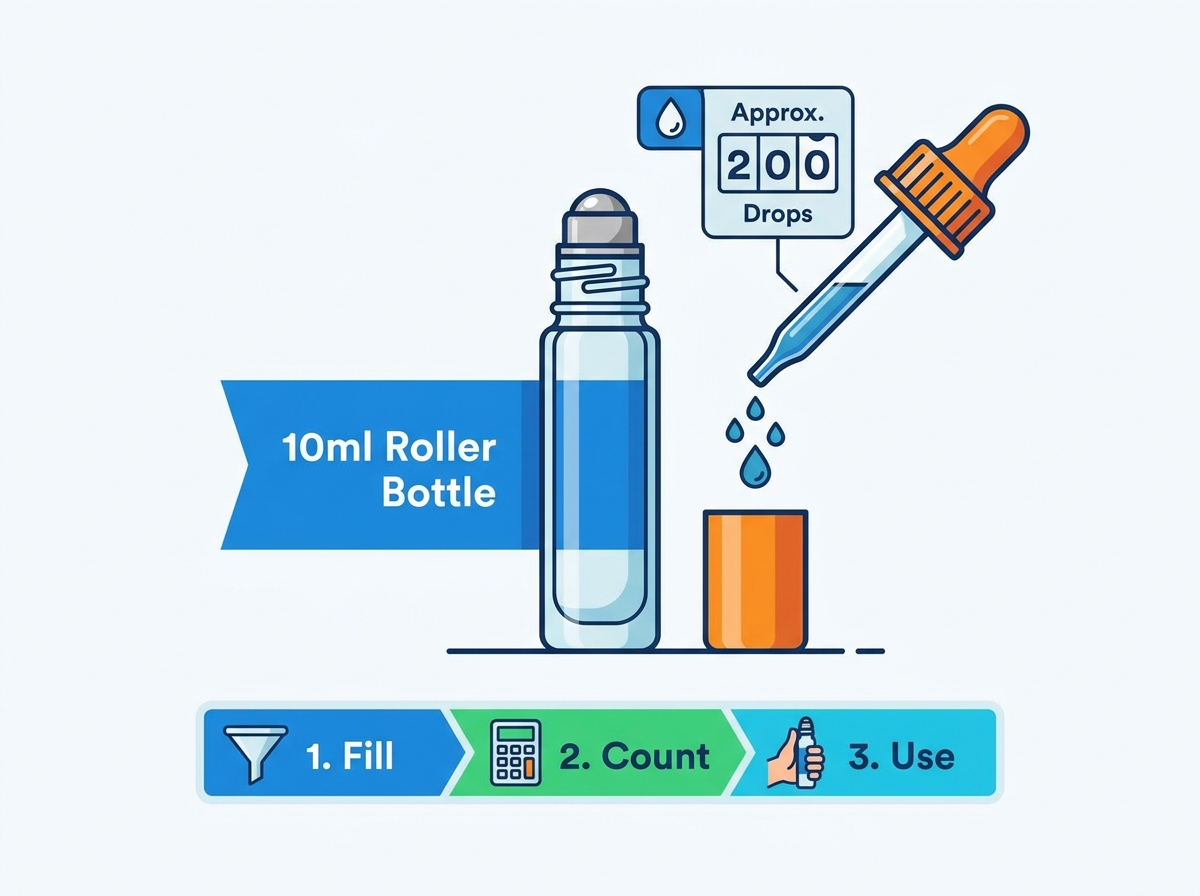
Standard Baseline: A standard 10ml roller bottle holds approximately 200 drops of total liquid, based on the industry metric of 20 drops per milliliter (mL).
Dilution Compliance: Safe topical application requires strict adherence to dilution charts; a 2% dilution in a 10ml bottle equates to exactly 4 drops of essential oil to 196 drops of carrier oil.
Variable Factors: Drop size is not absolute; it fluctuates based on fluid viscosity, temperature, and the specific dispensing mechanism (orifice reducer vs. pipette), which can push total bottle capacity anywhere from 200 to 400 drops.
Hardware Integrity: The quality of roller bottles (glass thickness, stainless steel vs. plastic fitments) directly impacts the shelf-life and leak-resistance of the final formulation.
Table of Contents
Establishing a reliable mathematical constant is mandatory for reproducible formulations. You cannot build a safe product line on guesswork. Formulators need a strict baseline to calculate active ingredient concentrations. Without this baseline, batches will vary wildly in potency and scent profile. Consistent drop counts ensure safety compliance and protect the end user from dermal irritation. This mathematical foundation also allows businesses to scale recipes from single units to large manufacturing runs seamlessly. When you know exactly how much liquid fits into your primary packaging, you can forecast raw material orders with absolute certainty.
The pharmacological and aromatherapeutic industries rely on a universally accepted metric. One milliliter (mL) of liquid equals approximately 20 drops. This standard assumes a water-like viscosity. Most carrier oils and thin essential oils align closely with this measurement. Laboratory equipment and standard Euro droppers are calibrated to this 20-drop baseline. Using this metric provides a universal language for formulators sharing recipes and safety guidelines globally. It removes the ambiguity of terms like "a dash" or "a splash" and replaces them with quantifiable data.
Calculating the total capacity requires basic multiplication. You multiply the 20-drop baseline by the 10 mL volume. This gives you a total capacity of 200 drops for a standard 10ml vessel. This 200-drop figure represents the entire liquid volume, including both the essential oil and the carrier oil. When a recipe calls for a specific percentage dilution, you calculate that percentage against the 200-drop total. This ensures the active ingredients remain properly balanced within the carrier medium. For example, a 1% dilution means 2 drops of essential oil and 198 drops of carrier oil.
Bottle Size (mL) | Industry Standard Drop Count (Total Capacity) | 1% Dilution (Essential Oil Drops) | 2% Dilution (Essential Oil Drops) |
|---|---|---|---|
1 mL | 20 drops | N/A (Requires micro-pipette) | N/A (Requires micro-pipette) |
2 mL | 40 drops | N/A (Requires micro-pipette) | 1 drop |
5 mL | 100 drops | 1 drop | 2 drops |
10 mL | 200 drops | 2 drops | 4 drops |
15 mL | 300 drops | 3 drops | 6 drops |
30 mL | 600 drops | 6 drops | 12 drops |
You will often find conflicting information regarding bottle capacity. Some industry sources cite 250 or even 400 drops per 10ml bottle. This discrepancy stems entirely from the dispensing mechanism used. Standard Euro droppers produce larger, heavier drops. Fine-gauge glass pipettes produce much smaller micro-drops. A narrow pipette can yield 25 to 40 micro-drops per milliliter. If you use a fine pipette, the 10ml bottle will indeed hold up to 400 micro-drops. You must identify which dispensing tool you are using before finalizing your formulation math. Mixing tools mid-batch will ruin your dilution ratios.
Total volume and usable volume are two different metrics. A 10ml bottle can technically hold 10 milliliters of liquid to the absolute brim. However, you must leave empty space at the top of the bottle. This empty space is called headspace or ullage. Inserting the rollerball fitment displaces liquid. The plastic housing and the metal ball have a specific volumetric footprint. If you fill the bottle to the top, pressing the fitment into place will cause the oil to overflow. Overflow wastes expensive ingredients and ruins the label adhesive. Always formulate for a usable volume of roughly 9.5 to 9.8 milliliters to accommodate the physical hardware.
The 200-drop rule serves as a reliable baseline, but it is not an absolute guarantee. Physical properties constantly alter the math behind your formulations. Drop size fluctuates based on several environmental and material factors. Understanding these variables prevents accidental over-concentration of active ingredients. You must evaluate fluid viscosity, dispensing tools, and ambient temperature to achieve true precision on the production floor.
Viscosity dictates how a fluid resists flow. Thin essential oils yield smaller, more frequent drops. Citrus oils like lemon, sweet orange, and bergamot flow rapidly. Eucalyptus and tea tree oils also share this thin consistency. Highly viscous oils behave entirely differently. Vetiver, patchouli, and sandalwood are thick and resinous. These heavy oils yield much larger, slower-forming drops. One drop of vetiver contains significantly more physical mass than one drop of lemon oil. You must account for this mass difference when blending thick resins into your carrier oil. If a recipe calls for thick oils, you may need to gently warm the bottle in a water bath to normalize the flow rate before dispensing.
Viscosity Category | Common Essential Oils | Flow Rate Characteristics | Impact on Drop Size |
|---|---|---|---|
Thin (High Flow) | Lemon, Sweet Orange, Eucalyptus, Tea Tree | Pours rapidly, requires careful handling to avoid over-pouring. | Produces smaller, lighter drops. May exceed 20 drops per mL. |
Medium (Standard Flow) | Lavender, Peppermint, Rosemary, Clary Sage | Steady, predictable drip rate from standard Euro droppers. | Aligns closely with the 20 drops per mL baseline. |
Thick (Low Flow) | Vetiver, Patchouli, Sandalwood, Myrrh | Sluggish, resinous. Often requires warming to dispense properly. | Produces large, heavy drops. Often yields fewer than 20 drops per mL. |
The physical tool you use to dispense the oil changes the volume of a single drop. Essential oil bottles typically feature an orifice reducer. The size of the hole in this plastic insert controls the flow rate. A large orifice reducer produces heavy drops. A small orifice reducer restricts flow, creating smaller drops. Furthermore, the angle at which you hold the bottle matters. Holding a bottle at a strict 90-degree angle produces a different drop size than holding it at a 45-degree angle. Glass pipettes introduce another variable. The gauge, or inner diameter, of the pipette tip directly alters drop size. A wide-tip pipette drops large volumes of liquid rapidly. A fine-tip pipette allows for granular control but requires a higher drop count to reach one milliliter.
Ambient temperature affects liquid density and flow rate. Cold environments cause oils to contract and thicken. A thick oil flows slower and forms larger drops. Warm environments cause oils to expand and thin out. A warm oil flows rapidly and forms smaller, more frequent drops. Formulating in a hot warehouse will yield different drop counts than formulating in an air-conditioned laboratory. You must maintain a consistent room temperature during the manufacturing process to ensure your drop sizes remain uniform across all batches. Standardize your facility temperature to 68°F - 72°F (20°C - 22°C) for optimal measuring consistency.
Mapping drop counts to established safety guidelines is non-negotiable. Topical application of undiluted essential oils causes severe adverse dermal reactions. You must dilute active ingredients in a carrier oil to ensure safe absorption. Different age groups and health profiles require specific maximum concentrations. Ignoring these dilution limits exposes users to chemical burns and systemic toxicity. Strict adherence to safety charts protects the consumer and shields the formulator from liability. Never assume a recipe found online is safe without verifying the math against the 200-drop baseline.
A standard daily-use recipe for healthy adults typically ranges from a 2% to 5% concentration. For short-term, localized use, adults can tolerate up to a 10% or 15% concentration. In a 10ml vessel, a 5% dilution requires 10 drops of essential oil. A 15% dilution requires 30 drops. You fill the remaining volume with your chosen carrier oil. These higher concentrations are strictly for acute issues like muscle tension or targeted blemish control. They are not suitable for full-body application or prolonged daily use. Always label high-concentration blends with clear usage warnings.
Age dictates dermal thickness and metabolic processing rates. You must adjust your drop counts based on the target demographic. The following framework outlines safe dilution parameters for a standard 10ml vessel.
Age Group | Target Dilution Percentage | Essential Oil Drop Count (10ml Bottle) | Usage Guidelines |
|---|---|---|---|
Newborn to 6 Months | 0.25% - 0.5% | 1 drop | Strict medical guidance advised. Use extreme caution. |
6 Months to 2 Years | 1% - 1.5% | 1 to 3 drops | Gentle oils only (e.g., Lavender, Roman Chamomile). |
2 to 5 Years | 1% - 2.5% | 2 to 5 drops | Monitor for skin sensitization. Apply to feet or back. |
5 to 12 Years | 2.5% - 5% | 5 to 10 drops | Safe for general localized use. |
Adult Daily Use | 2% | 4 drops | Standard dilution for daily cosmetic or aromatic wear. |
Once you understand the 10ml baseline, scaling the math becomes simple. A 5ml vessel holds half the volume, establishing a 100-drop baseline. To make a 2% dilution in a 5ml vessel, you simply halve the recipe. You would use 2 drops of essential oil instead of 4. A 30ml vessel holds roughly 600 drops. To achieve a 2% dilution in 30ml, you multiply the 4-drop baseline by three, requiring 12 drops. Always calculate your active ingredients against the total drop capacity of the specific vessel you are filling. Do not guess the volume based on the physical size of the glass.
Counting carrier oil drop by drop is highly inefficient for production. You should measure carrier oils in milliliters or grams. Fractionated coconut oil, jojoba oil, and sweet almond oil serve as excellent carrier mediums. For a 2% dilution in a 10ml vessel, you need 4 drops of essential oil. The remaining volume requires carrier oil. Instead of counting 196 drops, you simply measure out roughly 9.5 to 9.8 mL of carrier oil using a graduated cylinder or a calibrated pump. This method speeds up production while leaving adequate headspace for the rollerball fitment.
Selecting the physical hardware is just as important as the formulation itself. The hardware protects the active ingredients from degradation. It also dictates the end-user experience. Cheap hardware leaks, oxidizes oils, and ruins labels. High-grade hardware preserves the therapeutic properties of the blend and ensures smooth application. You must evaluate the fitment materials, glass quality, and cap threading before committing to a packaging supplier. Sourcing reliable Roller Bottles prevents catastrophic inventory loss during shipping and handling.
The fitment is the housing that holds the actual rollerball. This component interacts directly with the concentrated oils and the user's skin. You have three primary material options to choose from.
Stainless Steel: This material offers superior corrosion resistance. It provides a smooth, cooling application on the skin. Stainless steel does not degrade when exposed to high concentrations of citrus or resinous oils. It is the best choice for commercial products.
Glass: Glass rollerballs are chemically inert. They will not react with any essential oil profile. However, glass balls are prone to sticking inside the plastic housing. This results in uneven dispensing and a frustrating user experience.
Plastic: Plastic fitments are highly cost-effective. Unfortunately, they are highly susceptible to chemical degradation. Potent essential oils will eat away at cheap plastic over time. This causes the ball to fall out, spilling the entire contents of the vessel.
Ultraviolet light destroys the volatile compounds in essential oils. This process is called oxidation. Oxidized oils lose their therapeutic benefits and can cause severe skin irritation. Amber and cobalt blue glass provide high UV filtration. These dark colors block the light wavelengths that degrade active ingredients. Clear glass and frosted glass offer high aesthetic appeal. They showcase the color of the oil beautifully. However, clear glass offers zero UV protection. If you use clear glass, you must store the products in dark environments or opaque secondary packaging to prevent rapid degradation.
The cap seals the vessel and prevents oxygen ingress. Oxygen exposure ruins carrier oils, causing them to go rancid. You must evaluate the threading on both the glass neck and the cap interior. Precise threading ensures a tight, secure seal. Phenolic caps provide the highest level of security. They withstand the chemical nature of essential oils without cracking. Flimsy plastic caps often crack under pressure or loosen over time. A cracked cap leads to fluid leakage and total product loss during transit. Always test the torque tolerance of your caps before running a full production batch.
Translating drop counts into financial metrics is vital for small businesses. You cannot build a sustainable brand without knowing exactly what goes into each unit. Formulators must track the micro-cost of every ingredient. The total cost encompasses the active oils, the carrier medium, and the physical packaging. Balancing high-quality ingredients with premium hardware requires careful conceptual trade-offs. You must determine where to invest in quality and where to optimize for scale. Accurate tracking ensures your profit margins remain intact as you expand your product line.
You must calculate the micro-cost of your active ingredients to understand your true margins. First, determine the total drop count of your bulk essential oil supply. A standard 15ml bottle of essential oil holds roughly 300 drops. Divide the total cost of that bulk bottle by 300. This gives you the exact cost per drop. If your recipe requires 10 drops of that specific oil, multiply the cost per drop by 10. This formula reveals the precise financial weight of the active ingredients in your final blend. Repeat this process for every single oil in your recipe.
The active ingredients only represent one portion of the total cost. You must add the unit cost of the physical hardware. This includes the glass vessel, the roller fitment, and the cap. Next, calculate the cost of the carrier oil used to fill the remaining 9.5 mL of space. Add the active ingredient cost, the hardware cost, and the carrier oil cost together. This final number represents the total raw material cost per 10ml unit. Accurate tracking of these three categories prevents unexpected profit loss and allows you to forecast manufacturing budgets accurately.
Hand-counting drops is acceptable for small batches and personal use. It is entirely unsustainable for large commercial runs. Hand-counting introduces human error and slows down production timelines. As your operation scales, you must transition to volumetric or weight-based measuring. Using precision analytical balances to measure ingredients in grams ensures absolute consistency across thousands of units. Weight-based measuring eliminates the variable of drop size entirely. You calculate the specific gravity of each oil to convert milliliters to grams. This transition requires an upfront investment in lab equipment but drastically reduces long-term labor costs and batch rejections.
Assembling and storing filled vessels introduces several points of failure. Even a perfectly calculated formulation will fail if the packaging is compromised. Formulators face risks related to leakage, microbial growth, and ingredient degradation. You must implement strict standard operating procedures during the filling process. Anticipating these physical risks allows you to mitigate them before they reach the end consumer. A clean, organized workspace is your first line of defense against product failure.
Leakage is the most common failure point in this product category. Slow leaks ruin labels and damage shipping materials. Leaks occur when the roller fitment is not fully seated into the glass neck. Applying manual pressure with your thumbs is rarely sufficient. You must use a specialized roller bottle key or a mechanical press to seat the fitment. These tools apply even, downward pressure. You will hear a distinct click when the plastic housing locks into the glass ridge. Always test the seal by inverting the filled vessel and tapping it against a clean surface before applying the final cap.
Carrier oils provide a potential breeding ground for microbial growth if contaminated with water. You must sanitize all glass vessels and stainless steel rollers prior to filling. Wash the hardware in hot, soapy water and rinse thoroughly. Submerge the components in a high-proof isopropyl alcohol bath to kill remaining pathogens. Allow all parts to air dry completely in a sterile environment. Even a single drop of residual water can introduce bacteria into your final blend. Never use cloth towels to dry the interiors, as they leave behind lint and dust that will clog the rollerball mechanism.
Proper storage strategies maintain the efficacy of the blend over its intended shelf life. Volatile essential oils evaporate rapidly if exposed to air. Ensure caps are tightened immediately after the filling process is complete. Store all finished inventory in a temperature-controlled environment away from direct sunlight. Extreme heat accelerates oxidation and degrades the carrier oil. Always store the vessels in a vertical orientation. Storing them horizontally allows the concentrated oils to rest constantly against the plastic fitment housing, which can cause long-term material degradation and eventual leakage.
Moving from visual estimation to strict measurement protocols ensures product safety and business scalability. Relying on the 20-drop-per-mL standard provides a safe foundation for calculating dilution ratios, while prioritizing UV-resistant glass and stainless steel fitments protects the integrity of your mathematically precise blends.
Standardize a drop-to-mL conversion chart for the specific essential oils currently in your inventory.
Audit your hardware supply to ensure you are using stainless steel fitments and phenolic caps.
Calculate the exact cost per drop for your top three most expensive active ingredients.
Transition to weight-based gram measurements using an analytical balance to scale production beyond small batches.
Implement a strict three-step sanitization protocol for all glass and metal components prior to the filling stage.
DEMEI is a Shanghai-based cosmetic packaging manufacturer providing mold development, injection molding, hot stamping, printing, coating, UV printing, and assembly services. Supported by five affiliated factories and an annual production capacity of 100 million cosmetic-container sets, the company supplies scalable packaging solutions for essential oil, skincare, beauty, perfume, and personal care brands.
A: For a healthy adult, a safe daily-use 2% dilution requires exactly 4 drops of essential oil. For acute, short-term issues, you can use 10 to 30 drops to achieve a 5% to 15% concentration. Always fill the remaining volume with a high-quality carrier oil.
A: Drop size varies based on the dispensing tool. Standard Euro droppers yield about 20 drops per mL, totaling 200 drops. Fine-gauge glass pipettes produce much smaller micro-drops. These pipettes can yield 25 to 40 drops per mL, pushing the total count to 250 or 400 micro-drops.
A: For infants under 6 months, use extreme caution and seek medical guidance. Formulators typically use 1 drop or less. For toddlers aged 2 to 5 years, use a 1% to 2.5% dilution. This equals 2 to 5 drops of a gentle essential oil per 10ml vessel.
A: Plastic vessels are highly susceptible to chemical degradation. Concentrated essential oils, especially citrus and resinous profiles, will slowly dissolve cheap plastics. This leads to leakage and product contamination. Always prioritize glass vessels with stainless steel fitments for essential oil formulations.
A: Fractionated coconut oil is the industry standard. It remains liquid at room temperature, has no distinct odor, and boasts a very long shelf life. Jojoba oil and sweet almond oil are also excellent choices for rapid skin absorption and hydration.
A: Leaks typically occur because the rollerball fitment is not fully seated into the glass neck. Manual thumb pressure is often insufficient. Use a specialized roller key tool to apply even downward pressure until the plastic housing clicks securely into the glass ridge.
A: You should leave approximately 0.2 to 0.5 mL of empty space at the top of the vessel. This headspace accommodates the physical displacement caused by inserting the rollerball fitment. Filling the glass to the absolute brim will cause the oil to overflow during assembly.


